Professor
Robert Blobaum, Eberly Family Professor at West Virginia University (Morgantown, WV), discussed World War I, Buffalo, and the practical side of history
in an interview with Tomasz Pudłocki (Assistant Professor of History,
Jagiellonian University; Fulbright Scholar-in-Residence at Daemen College).
 |
| Prof. Robert Blobaum |
Tomasz Pudłocki: Not long ago, you participated in a
conference on World War I (Death of
Empires) at Daemen College in Amherst, NY. As the keynote speaker, you
delivered a presentation on Warsaw during the Great War. How were you able to
place events in Warsaw within the broader context of “the death of
empires?” What can we say about life in this city during WWI?
Robert Blobaum: It was Warsaw’s fate to bear witness to the collapse of two of them during the First World War—that of the Russian Empire, which for Warsaw effectively occurred in August 1915 when the Russians were forced to evacuate the city, never to return, and then that of the Second German Reich whose forces occupied the city following the Russian withdrawal, only themselves to depart in the fall of 1918. One is tempted to add a third empire to this mix, the Austro-Hungarian, but its presence in the city was essentially a diplomatic one of ever dwindling influence. In many ways, life in Warsaw during the war was similar to that in imperial capitals such as Vienna, Berlin and St. Petersburg, particularly in regard to the experience of food supply, quality and distribution. In other ways, however, it was significantly different, for example, in the high level of unemployment and massive out-migration, voluntary and involuntary, of much of its working-age male population.
T. P.: You are well-known for your works on the Polish lands before 1914. Why did you decide to study World War I? Was it because of the centenary or is it a part of your broader interest?
R.B.: In part, it was a natural progression for me, after my earlier studies of the Kingdom of Poland and Warsaw before the First World War. I had planned to move on to the First World War somewhat earlier but another project, the organization and editing of a collaborative volume on antisemitism in modern Poland, intervened in the meantime. The centenary only came into play once I was finally able to begin my research on Warsaw during the war in 2008.
T.P.: You have studied Poland and Polish history for many years, and you have authored many books and articles. You have won many awards for your innovative approaches to issues in Polish history. Could you tell us how you became interested in Polish history?
R.B.: My original interest was actually focused on imperial and revolutionary Russia. The role of Poland and Poles in that history, however, had led me westward by the time I began my doctoral studies, eventually to my dissertation on Feliks Dzierżyński and then later to the Revolution of 1905 in the Kingdom of Poland.
T.P.: Is it easy to speak to an American audience about Polish affairs? Many Americans have trouble locating Poland on a map, not to mention the difficulties of pronouncing Polish names. Does this affect the popularity of your research?
R.B.: Americans have difficulty with names in any other language other than English. Only a minority are able to pronounce my German surname properly. Once, however, Americans realize that they cannot hope to understand European history and affairs, particularly in the modern era, without knowledge of Poland at its epicenter, it’s a much easier sell. One can make the argument that Poland is as relevant as France and Great Britain, if not more so, to modern European history, but to do that it is necessary to demonstrate that Polish history is not and never has been peripheral. Given Poland’s location on the map of Europe, how could it be?
T.P.: Do you have any advice for students who are interested in Central and Eastern Europe? To what areas of research would you turn their attention?
R.B.: My first piece of advice is to familiarize themselves with one or more languages of the region. For example, to do Polish history justice, one should know at least four languages in addition to English: Polish, of course, but also Russian, German and Yiddish, not to mention Ukrainian, Belorusian, and Lithuanian. While I have some kind of proficiency in three of these of languages, I regret to this day that Yiddish is not among them. As for areas of research, the field is wide open. For example, when I have been asked to compare the experience of the Great War in Warsaw with that of other Polish cities, I can do so only in the most general terms because that work hasn’t been done in any systematic way for places like Kraków, Lwów, Poznań, Łódź, etc. Even for the Second World War, until the recent appearance of Joshua Zimmerman’s book on the Polish underground and the Jews this year, no serious scholarly monograph has gone beyond stereotypes to treat that controversial topic in a dispassionate and impartial way. In any event, there is much to do in practically every area of Central and East European history.
T.P.: And what about the nationality/ethnicity of the researcher? In your opinion, is it a factor that helps or hinders his/her research? Or does it matter?
R.B.: It shouldn’t matter but it has in the past, especially in dealing with issues of interethnic relations. One’s ethnicity can be beneficial, in adding nuance and insight about group thinking. Or it can be harmful, a source of bias and stereotypes. Often, one’s ethnicity is held against or in favor of the researcher, without any basis in the quality of research itself. For example, I have often been assumed to be Jewish because of my surname, which then has been said to disqualify me from making pronouncements on the history of Polish-Jewish relations. On the other hand, my actual status as a third-generation American of German descent for some has presumably endowed me with impartiality in dealing with such issues.
T.P.: Do you believe that universities and colleges in Buffalo, such as Daemen College, are good places to study Central and Eastern Europe?
R.B.: Definitely. First, because Buffalo and other cities on the Great Lakes and in the upper Midwest were major destinations of the Central and East European immigrants, so there is a natural audience of those looking to understand their roots beyond mere genealogy. Secondly, colleges like Daemen have recruited faculty, people like Professor Andrew Wise, who are skilled researchers and program builders. The “Death of Empires” conference is a testimony to such efforts, as was the amazing Nikifor exhibit at Daemen, organized by Professor Wise.
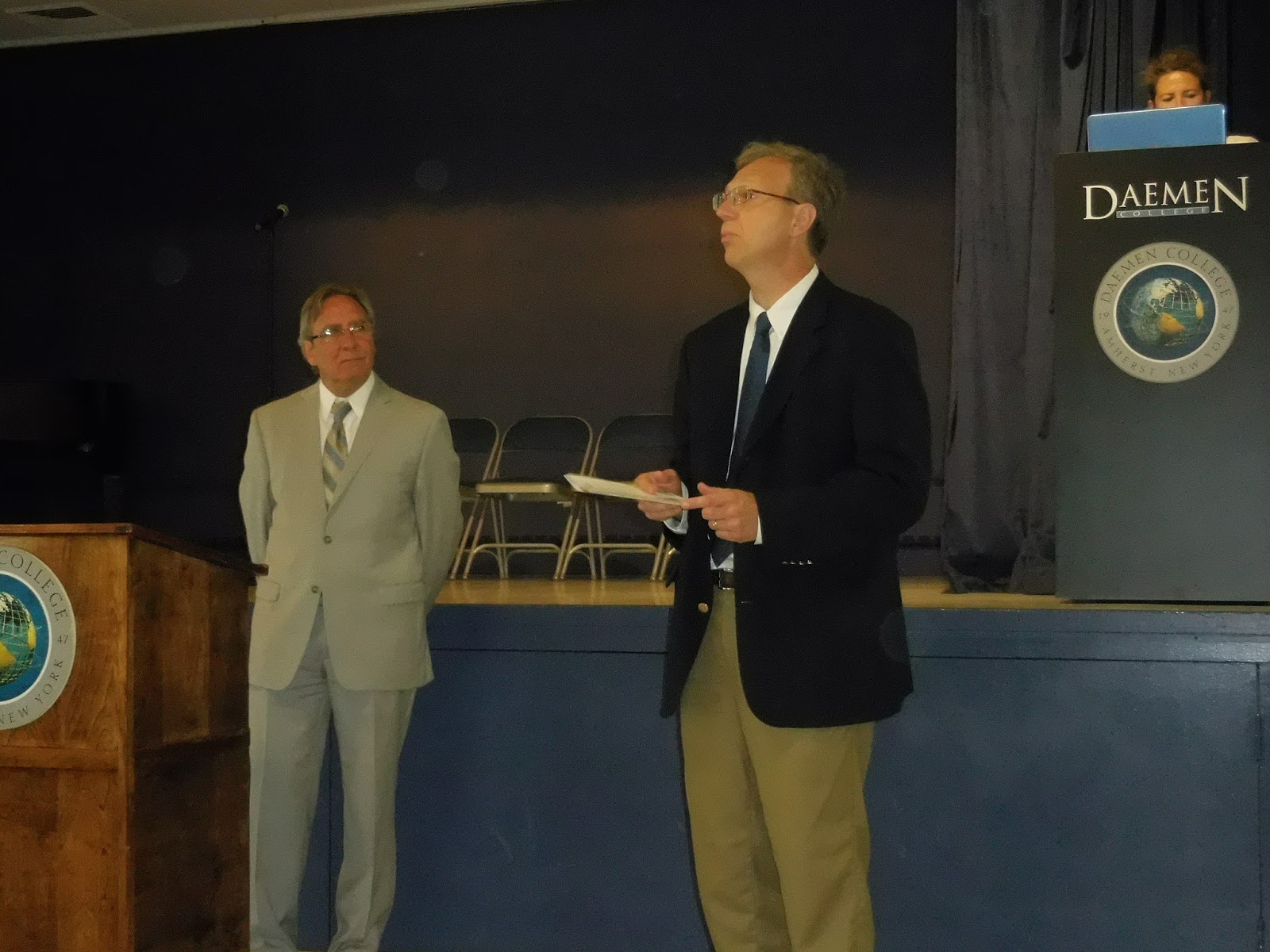 |
| Prof. Robert Blobaum and Dr. Andrew Wise |
 |
| Dr. Wise, Prof. Blobaum, and Dr. Tomasz Pudlocki |
T.P.: In Poland, students often ask about the viability of degrees in the humanities. Are there jobs in the USA for persons interested in studying the history of Central or Eastern Europe?
R.B.: There are jobs, but not necessarily in the academy or in teaching. The private business sector in the United States, for example, hires more holders of Humanities degrees than one might imagine because it values research skills on the one hand, and communication skills necessary to relay information derived from research on the other. Often, private businesses have found that graduates of business schools and engineering programs don’t possess these important skills. My advice to students interested in the Humanities is to follow their passion, but combine that passion with at least some academic coursework and training in another discipline.
T.P.: I have the impression that the anniversaries connected with World War I (the Great War) are of greater interest to Europeans than Americans. There seem to be many more commemorations in Europe than in the USA. Why is this the case?
R.B.: The main reason is that the United States entered the war relatively late, officially in April 1917, but not until a year later did Americans appear in the trenches of the western front. The Great War was not nearly as traumatic for Americans as it was for Europeans. This is more important than the fact that none of the war was fought on American soil, which could also be said of the Second World War, but it is far more commemorated. Of course, how and to what extent the Great War is commemorated in Europe varies significantly from country to country as well.
T.P.: In conclusion, I would like to ask you about your forthcoming plans. The presentation at the “Death of Empires” conference at Daemen College is part of a larger book project. Could you share some thoughts about any other research projects?
R.B.: First, I need to see my book on Warsaw during the Great War through to publication. That will take a year of revisions, editing, securing permissions for photographs and other images, indexing, etc. Academic book publishing in the U.S. is a long process, even after a contract is signed. I also need to see through some smaller projects that have been accepted for publication—one on Polish-Jewish relations in Warsaw during the Great War, another on the role and limitations of "ego-documents” (personal correspondence, diaries, accounts, testimonies, memoirs) in conducting research on everyday life during wartime. Beyond that, we need to remember that Warsaw remained a city at war after the Great War, only now as the capital city of an independent Poland. While the Polish-Soviet war has been fairly well researched, we know little about its impact on living conditions in Warsaw, particularly as it became a frontline city in that conflict. Finally, I have been approached about co-organizing and editing a collaborative volume devoted to research on the social and cultural history of Central and East European cities during the Great War, cities which have yet to be examined and certainly not in any comparative way. I have already mentioned Polish cities like Poznań, Kraków, Łódź and Lwów, but cities like Budapest, Prague, Belgrade, Bratislava, and Vilnius—the list could go on—would also be included.

.jpg)


