
Showing posts with label Tomasz Pudlocki. Show all posts
Showing posts with label Tomasz Pudlocki. Show all posts
Wednesday, September 12, 2018

Saturday, March 17, 2018
1918-2018: Center for Polish Studies at Daemen College hosts Conference on Polish Independence
"For Your Freedom and Ours:" Polonia and the Struggle for Polish Independence
The keynote speaker will be award-winning historian Prof. James Pula. Related events will include a tour of the special exhibition on "Camp Kosciuszko: The Polish Army at Niagara Camp, 1917-1919" at the Niagara Historical Society & Museum (Niagara-on-the-Lake, Ontario), a guided tour of other sites associated with Camp Kosciuszko, and a performance of music by Ignacy Paderewski by the Chopin Singing Society of Buffalo. A volume of select papers will be published by the Society of Friends of Learning in Przemysl.
For full details, see the Call For Papers at H-Net.
Organizers for the conference are Prof. Andrew Wise (Daemen College) and Prof. dr. hab. Tomasz Pudlocki (Jagiellonian University). For more information, please contact Andrew Wise at awise@daemen.edu.
Tuesday, March 13, 2018
Updates from Jagiellonian University
 |
| Jagiellonian University CEES Winter School Students at Krasiczyn |
Studies in Central and Eastern Europe (CEES): Histories, Cultures, and Societies
Prof. Andrew Kier Wise (Professor of History/Chair, Center for Polish Studies at Daemen College) is teaching several courses this semester in an innovative new program at Jagiellonian University's Institute of History. Directed by Prof. dr. hab. Tomasz Pudlocki, the CEES program brings students from around the world to Krakow to study the history of Poland and the broader region. For more information, please click here:http://www.ceestudies.historyczny.uj.edu.pl/start
From 12-16 February, Prof. Wise accompanied Prof. Pudlocki, Ph.D. student Kamil Ruszala, and a dozen CEES students on a Winter School trip filled with site visits, lectures by faculty, and presentations by the students. Sites and cities on the itinerary included: Kolbuszowa, Sandomierz, Baranow Sandomierski, Kazimierz Dolny, Pulawy, Lublin, Zamosc, Belzec, Lancut, Krasiczyn, Przemysl, Sanok, and Tarnow.
 |
| Image of Ship Bringing Immigrants to Buffalo inside Wooden Church at Museum of Folk Culture in Kolbuszowa |
 |
| CEES Students in Zamosc |
 |
| Krasiczyn Castle on a Snowy Day |
 |
| CEES Winter School Students with Przemysl High School Students |
 |
| Prof. Pudlocki's Winter School Lecture at Przemysl High School |
Prof. Wise also presented a lecture to these groups of students at the Society of Friends of Learning in Przemysl (Towarzystwo Przyjaciol Nauk w Przemyslu, or TPN).
 |
| Prof. Wise's Winter School Lecture at TPN |
Jagiellonian Polonia Institute at Daemen College -- Planned for 2019
For more details about the Jagiellonian Polonia Institute at Daemen College, please contact Prof. Wise at awise@daemen.edu.
Sunday, March 11, 2018
Prof. Andrew Wise Delivers Public Lecture at Kosciuszko Foundation in Washington, D.C.
 |
| L-R: Tomasz Pudlocki, Magdalena Baczewska, Janusz Romanski, and Andrew Wise |
The year 2018 marks the 100th anniversary of the rebirth of the Polish state, and the Center for Polish Studies at Daemen College and its affiliated faculty are actively engaging students and community partners in Buffalo, the US, and Poland in commemorating this event of worldwide significance.
En route to Poland to teach at Jagiellonian University for the spring semester, Prof. Andrew Kier Wise (Professor of History and Chair, Polish Studies Center) joined Prof. dr. hab. Tomasz Pudlocki (Professor of History, Jagiellonian University) and Dr. Magdalena Baczewska (Director of Music Performance Program, Columbia University) for an evening of programming at the Kosciuszko Foundation in Washington, DC. Prof. Pudlocki is the coordinator in Poland for Daemen's study abroad program, which brings Daemen students to Poland during the summer session. He also was a Fulbright Scholar in Residence at Daemen College in fall 2015.
Entitled "Between Music and Diplomacy: The Founding Fathers of WWI American-Polish Rapprochement," the event featured lectures by Prof. Pudlocki and Prof. Wise and a piano performance by Dr. Baczewska. Prof. Pudlocki provided a cogent and in-depth analysis of the historical events surrounding American-Polish collaboration during World War I. Prof. Wise focused on the activities in the US and Europe of Buffalo Health Commissioner Dr. Francis Fronczak, who was a close friend of Ignacy Paderewski and a member of the Polish National Committee. An accomplished concert pianist and recording artist, Dr. Baczewska performed on the piano and also provided scholarly commentary about the Paderewski pieces that she selected.
Co-sponsored by the Polish Cultural Institute (New York) and the Kosciuszko Foundation (Washington, DC Center), the event was well-attended by community members, scholars, and representatives from the Polish Embassy. Please click here for one review in the Polish-American press: https://www.kurierplus.com/2018/02/5365/miedzy-muzyka-i-dyplomacja/. The photo below includes event organizers Magdalena Mazurek (Polish Cultural Institute New York), Barbara Bernhardt (Kosciuszko Foundation, Washington, DC Center), and Anna Domanska (Polish Cultural Institute New York).
Entitled "Between Music and Diplomacy: The Founding Fathers of WWI American-Polish Rapprochement," the event featured lectures by Prof. Pudlocki and Prof. Wise and a piano performance by Dr. Baczewska. Prof. Pudlocki provided a cogent and in-depth analysis of the historical events surrounding American-Polish collaboration during World War I. Prof. Wise focused on the activities in the US and Europe of Buffalo Health Commissioner Dr. Francis Fronczak, who was a close friend of Ignacy Paderewski and a member of the Polish National Committee. An accomplished concert pianist and recording artist, Dr. Baczewska performed on the piano and also provided scholarly commentary about the Paderewski pieces that she selected.
Co-sponsored by the Polish Cultural Institute (New York) and the Kosciuszko Foundation (Washington, DC Center), the event was well-attended by community members, scholars, and representatives from the Polish Embassy. Please click here for one review in the Polish-American press: https://www.kurierplus.com/2018/02/5365/miedzy-muzyka-i-dyplomacja/. The photo below includes event organizers Magdalena Mazurek (Polish Cultural Institute New York), Barbara Bernhardt (Kosciuszko Foundation, Washington, DC Center), and Anna Domanska (Polish Cultural Institute New York).
 |
| L-R: Magdalena Mazurek, Barbara Bernhardt, Prof. Pudlocki, Magdalena Baczewska, Andrew Wise, and Anna Domanska |
Sunday, November 29, 2015
Roundtable Discussion of Russia's War on Terror
On Monday, November 16, Dr. Michael Slobodchikoff and Dr.
Tomasz Pudlocki led a roundtable discussion on Russia’s War on Terror, as part
of the History and Political Science Speaker Series. The event was well attended, as Drs.
Slobodchikoff and Pudlocki spoke to over 100 people in the audience.

Dr. Slobodchikoff spoke about Syria’s civil war and how ISIL
factors into the problems in Syria, as it is the major opposition faction in
Syria. He also spoke about Russia’s interests
in Syria as well as the surrounding Middle Eastern region. These interests include preventing extremism
and terrorism from spreading to Russia, protecting long-time allies, protecting
military bases, protecting business interests, among many others.

Dr. Slobodchikoff also spoke about recent terrorist
activity. Russian Flight 9268 crashed en
route to St. Petersburg, Russia from Sharm el Sheikh, Egypt. ISIL took credit for the crash, which Russia
responded to by cancelling all flights to and from Egypt. He also spoke about the recent attacks on
Paris, France. ISIL has also claimed
credit for the bombings and death of over 100 people in these attacks.


Dr. Pudlocki spoke about the Syrian crisis from the
perspective of Central Europe. He
discussed the current refugee crisis as a result of the Syrian civil war,
economic downturn, and terrorist activity.
He commented on how central Europe has been responding to the influx of
refugees and the struggles faced by these refugees fleeing terror in their home
countries.


The Department of History and Political Science would like
to thank Dr. Slobodchikoff and Dr. Pudlocki for an engaging roundtable on this
very relevant topic. We also thank the
Division of Arts and Sciences for co-sponsoring the event.
For more information on this roundtable discussion, you can see press coverage of the event at the links provided below. The History and Political Science Department was happy to see some of our students featured in the reports!
Thursday, October 29, 2015
Russia's War on Terror
The faculty of the History and Political Science Department invite you to attend a Roundtable Discussion focused on Russia's War on Terror.

Monday, October 19, 2015
Interview with Professor Robert Blobaum, Eberly Family Professor at West Virginia University
Professor
Robert Blobaum, Eberly Family Professor at West Virginia University (Morgantown, WV), discussed World War I, Buffalo, and the practical side of history
in an interview with Tomasz Pudłocki (Assistant Professor of History,
Jagiellonian University; Fulbright Scholar-in-Residence at Daemen College).
 |
| Prof. Robert Blobaum |
Tomasz Pudłocki: Not long ago, you participated in a
conference on World War I (Death of
Empires) at Daemen College in Amherst, NY. As the keynote speaker, you
delivered a presentation on Warsaw during the Great War. How were you able to
place events in Warsaw within the broader context of “the death of
empires?” What can we say about life in this city during WWI?
Robert Blobaum: It was Warsaw’s fate to bear witness to the collapse of two of them during the First World War—that of the Russian Empire, which for Warsaw effectively occurred in August 1915 when the Russians were forced to evacuate the city, never to return, and then that of the Second German Reich whose forces occupied the city following the Russian withdrawal, only themselves to depart in the fall of 1918. One is tempted to add a third empire to this mix, the Austro-Hungarian, but its presence in the city was essentially a diplomatic one of ever dwindling influence. In many ways, life in Warsaw during the war was similar to that in imperial capitals such as Vienna, Berlin and St. Petersburg, particularly in regard to the experience of food supply, quality and distribution. In other ways, however, it was significantly different, for example, in the high level of unemployment and massive out-migration, voluntary and involuntary, of much of its working-age male population.
T. P.: You are well-known for your works on the Polish lands before 1914. Why did you decide to study World War I? Was it because of the centenary or is it a part of your broader interest?
R.B.: In part, it was a natural progression for me, after my earlier studies of the Kingdom of Poland and Warsaw before the First World War. I had planned to move on to the First World War somewhat earlier but another project, the organization and editing of a collaborative volume on antisemitism in modern Poland, intervened in the meantime. The centenary only came into play once I was finally able to begin my research on Warsaw during the war in 2008.
T.P.: You have studied Poland and Polish history for many years, and you have authored many books and articles. You have won many awards for your innovative approaches to issues in Polish history. Could you tell us how you became interested in Polish history?
R.B.: My original interest was actually focused on imperial and revolutionary Russia. The role of Poland and Poles in that history, however, had led me westward by the time I began my doctoral studies, eventually to my dissertation on Feliks Dzierżyński and then later to the Revolution of 1905 in the Kingdom of Poland.
T.P.: Is it easy to speak to an American audience about Polish affairs? Many Americans have trouble locating Poland on a map, not to mention the difficulties of pronouncing Polish names. Does this affect the popularity of your research?
R.B.: Americans have difficulty with names in any other language other than English. Only a minority are able to pronounce my German surname properly. Once, however, Americans realize that they cannot hope to understand European history and affairs, particularly in the modern era, without knowledge of Poland at its epicenter, it’s a much easier sell. One can make the argument that Poland is as relevant as France and Great Britain, if not more so, to modern European history, but to do that it is necessary to demonstrate that Polish history is not and never has been peripheral. Given Poland’s location on the map of Europe, how could it be?
T.P.: Do you have any advice for students who are interested in Central and Eastern Europe? To what areas of research would you turn their attention?
R.B.: My first piece of advice is to familiarize themselves with one or more languages of the region. For example, to do Polish history justice, one should know at least four languages in addition to English: Polish, of course, but also Russian, German and Yiddish, not to mention Ukrainian, Belorusian, and Lithuanian. While I have some kind of proficiency in three of these of languages, I regret to this day that Yiddish is not among them. As for areas of research, the field is wide open. For example, when I have been asked to compare the experience of the Great War in Warsaw with that of other Polish cities, I can do so only in the most general terms because that work hasn’t been done in any systematic way for places like Kraków, Lwów, Poznań, Łódź, etc. Even for the Second World War, until the recent appearance of Joshua Zimmerman’s book on the Polish underground and the Jews this year, no serious scholarly monograph has gone beyond stereotypes to treat that controversial topic in a dispassionate and impartial way. In any event, there is much to do in practically every area of Central and East European history.
T.P.: And what about the nationality/ethnicity of the researcher? In your opinion, is it a factor that helps or hinders his/her research? Or does it matter?
R.B.: It shouldn’t matter but it has in the past, especially in dealing with issues of interethnic relations. One’s ethnicity can be beneficial, in adding nuance and insight about group thinking. Or it can be harmful, a source of bias and stereotypes. Often, one’s ethnicity is held against or in favor of the researcher, without any basis in the quality of research itself. For example, I have often been assumed to be Jewish because of my surname, which then has been said to disqualify me from making pronouncements on the history of Polish-Jewish relations. On the other hand, my actual status as a third-generation American of German descent for some has presumably endowed me with impartiality in dealing with such issues.
T.P.: Do you believe that universities and colleges in Buffalo, such as Daemen College, are good places to study Central and Eastern Europe?
R.B.: Definitely. First, because Buffalo and other cities on the Great Lakes and in the upper Midwest were major destinations of the Central and East European immigrants, so there is a natural audience of those looking to understand their roots beyond mere genealogy. Secondly, colleges like Daemen have recruited faculty, people like Professor Andrew Wise, who are skilled researchers and program builders. The “Death of Empires” conference is a testimony to such efforts, as was the amazing Nikifor exhibit at Daemen, organized by Professor Wise.
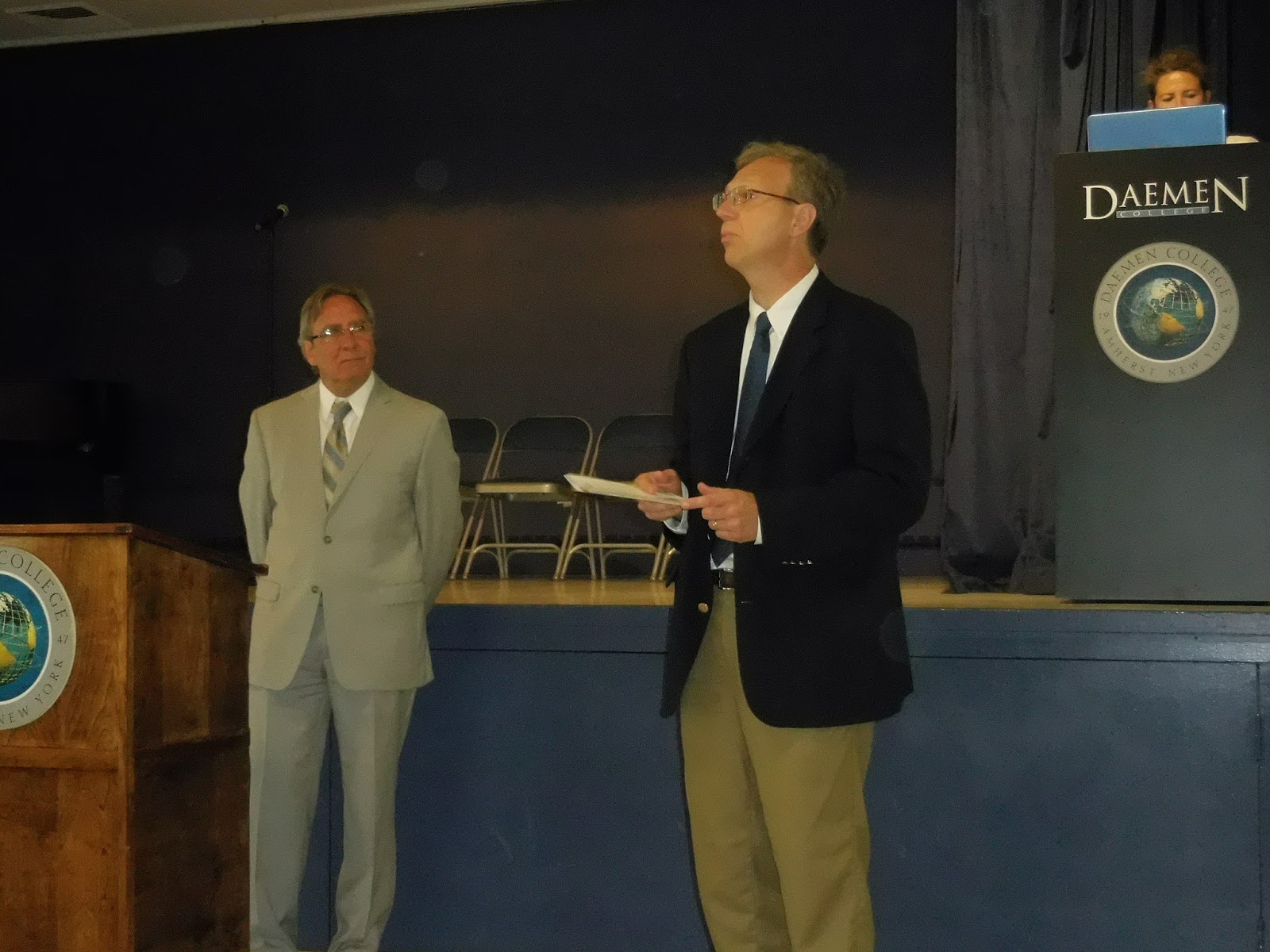 |
| Prof. Robert Blobaum and Dr. Andrew Wise |
 |
| Dr. Wise, Prof. Blobaum, and Dr. Tomasz Pudlocki |
T.P.: In Poland, students often ask about the viability of degrees in the humanities. Are there jobs in the USA for persons interested in studying the history of Central or Eastern Europe?
R.B.: There are jobs, but not necessarily in the academy or in teaching. The private business sector in the United States, for example, hires more holders of Humanities degrees than one might imagine because it values research skills on the one hand, and communication skills necessary to relay information derived from research on the other. Often, private businesses have found that graduates of business schools and engineering programs don’t possess these important skills. My advice to students interested in the Humanities is to follow their passion, but combine that passion with at least some academic coursework and training in another discipline.
T.P.: I have the impression that the anniversaries connected with World War I (the Great War) are of greater interest to Europeans than Americans. There seem to be many more commemorations in Europe than in the USA. Why is this the case?
R.B.: The main reason is that the United States entered the war relatively late, officially in April 1917, but not until a year later did Americans appear in the trenches of the western front. The Great War was not nearly as traumatic for Americans as it was for Europeans. This is more important than the fact that none of the war was fought on American soil, which could also be said of the Second World War, but it is far more commemorated. Of course, how and to what extent the Great War is commemorated in Europe varies significantly from country to country as well.
T.P.: In conclusion, I would like to ask you about your forthcoming plans. The presentation at the “Death of Empires” conference at Daemen College is part of a larger book project. Could you share some thoughts about any other research projects?
R.B.: First, I need to see my book on Warsaw during the Great War through to publication. That will take a year of revisions, editing, securing permissions for photographs and other images, indexing, etc. Academic book publishing in the U.S. is a long process, even after a contract is signed. I also need to see through some smaller projects that have been accepted for publication—one on Polish-Jewish relations in Warsaw during the Great War, another on the role and limitations of "ego-documents” (personal correspondence, diaries, accounts, testimonies, memoirs) in conducting research on everyday life during wartime. Beyond that, we need to remember that Warsaw remained a city at war after the Great War, only now as the capital city of an independent Poland. While the Polish-Soviet war has been fairly well researched, we know little about its impact on living conditions in Warsaw, particularly as it became a frontline city in that conflict. Finally, I have been approached about co-organizing and editing a collaborative volume devoted to research on the social and cultural history of Central and East European cities during the Great War, cities which have yet to be examined and certainly not in any comparative way. I have already mentioned Polish cities like Poznań, Kraków, Łódź and Lwów, but cities like Budapest, Prague, Belgrade, Bratislava, and Vilnius—the list could go on—would also be included.
Thursday, August 27, 2015
Death of Empires: A Multidisciplinary Humanities Conference on World War I at Daemen College: September 18-19, 2015
World War I and the Death of Empires Conference
The historical and literary legacy of World War I is the focus of the Death of Empires Conference scheduled for September 18-19, 2015, at Daemen College (4380 Main Street, Amherst, NY).
The Death of Empires Conference is presented by the Departments of English; History & Political Science; and Visual & Performing Arts at Daemen College. The conference will bring together humanities scholars, humanities educators, and the general public to share research findings and explore the impact of the Great War on the home front and the battlefront, as well as the war's place in public memory. Members of the general public and students are invited to attend the academic sessions along with the related performances and exhibits, which examine the meaning and legacy of World War I through a variety of academic disciplines and media. All events are free and open to the public.
 |
| Dog made of foil from cigarette packets in France during World War I
by Private William Farrar. Farrar served in the West Yorkshire Regiment of
the British army and was killed in fighting in 1916.
(Collection of Dr. Robert Waterhouse)
|
Planned to coincide with the centennial anniversary of the war, the conference
features humanities-based academic and artistic presentations that
consider the pivotal role of World I in bringing about the death of
empires and the creation of a new world order. Sometimes described as
the first "modern war," World War I erased distinctions between "war
front" and "home front," amplified ethnic tensions, and signaled the
limits of imperial power in ways that continue to resonate today.
 |
| Trench warfare. (Photo courtesy of Zenon Harasym) |
The Death of Empires Conference includes five components: I. Research Presentations by
American and international scholars organized into panel sessions; II. "The Collapse of Empires: The View from Warsaw (Poland) During World War I," conference keynote address by Dr. Robert Blobaum; III. "The Rose that Grows in No Man's Land," a theatrical reading of women's wartime writing by Buffalo's Red Thread Theatre Company; IV. "Little Empires: Toy Soldiers during the Great War, 1914-1918," an exhibit of military-themed toys; and V. Nikifor Exhibit: artworks by "primitive" artist Nikifor Krynicki
(1895-1968) from the Lemko region of
Poland. (Keep reading for more details about each part of the conference.)
* * *
 |
| "Changes to Europe After World War I," from "40 Maps that Explain World War I" |
I. RESEARCH PRESENTATIONS BY AMERICAN AND INTERNATIONAL SCHOLARS Saturday, September 19. Papers are organized into four panel sessions (8:15-10:00am, 10:15-12:00, 2:30-4:00pm, and 4:15-5:45pm) in RIC 120 (Research and Information Commons.)
- Keeping the Lost Empire Alive in Nazi Germany (Willeke Sandler, Loyola University)
- Gun Smoke in Lettow’s Jungle: German East Africa Between the Wars (Thomas Pennington, New York University)
- Remembering an Ottoman War: The Great War and the ‘Other’ in Modern Turkey (Pheroze Unwalla, York University)
- Chair & Comment by Penny Messinger (Daemen College)
Session 2: The War at Home: British and American Women’s World War I Fiction (10:15-12:00, RIC 120)
- Larsen’s Brian Redfield: The African American War Veteran in Passing (Jennifer Haytock, College at Brockport, SUNY)
- ‘Food is a Weapon’: From Farming to Fighting in Willa Cather’s One of Ours (Stacy Hubbard, University at Buffalo, SUNY)
- ‘Not intimate enough a contact’: Sensory Experience in The Return of the Soldier (Hannah Fogerty, University at Buffalo, SUNY)
- ‘This Is Not Fanciful’: Gertrude Stein’s Ambulance Work in the Great War (Christopher Leslie, New York University)
- Chair & Comment by Charlie Wesley (Daemen College)
Session 3: Untold Stories of an Empire in Peril: Belgium and Its Colony during World War I (2:30-4:00, RIC 120)
- Untold Stories: Invading Homes. Billeting in Belgium’s Etappengebiet (1914-1918). A Story of Living in Harmony? (Sebastiaan Vanderbogaerde, Ghent University)
- ‘We did not go to war for Congo, but for Belgium’. Congolese Soldiers and Carriers facing the First World War (Enika Ngongo, Université Saint-Louis-Bruxelles)
- Untold stories: Cohabitating with the Allies. Canadian troops on the Ypres Salient (1915-1918) (Nathalie Tousignant, Université Saint-Louis-Bruxelles)
- Chair & Comment by Andrew Kier Wise (Daemen College)
Session 4: The Birth of a New World Order (4:15-5:45, RIC 120)
- Gender and Nation or Nation and Gender? Wincenta Tarnawska as a Case Study from the Periphery of World War I (Tomasz Pudłocki, Jagiellonian University)
- From Buffalo to Moscow: Anna and Boris Reinstein and the Socialist Response to the First World War (Penny Messinger and Andrew Kier Wise, Daemen College)
- A Document to End all Freedom of Movement: World War I and the Birth of the Modern Passport System (Yaron Jean, University of Haifa)
- Chair & Comment by Hamish Dalley (Daemen College)
 |
| "European Powers Carve Up Africa," from "40 Maps that Explain World War I" |
* * *
II. DR. ROBERT BLOBAUM, "THE COLLAPSE OF EMPIRES: THE VIEW FROM WARSAW (POLAND) DURING WORLD WAR I," conference keynote address. Saturday, September 19, 1:00-2:15pm (Social Room, Wick Center)
- Dr Robert Blobaum, a noted historian with expertise in the history of Poland and Eastern Europe, will deliver the keynote address for the conference, "The Collapse of Empires: The View from Warsaw (Poland) during World War I," based on research for his forthcoming book manuscript. Dr. Blobaum is Eberly Family Distinguished Professor of History at West Virginia University.
 |
| Keynote speaker Dr. Robert Blobaum |
In his lecture, Dr. Blobaum will discuss the collapse of first Russian and then German imperial power in 1915 and 1918 respectively from the perspective of the Warsaw street. He will also address the existential catastrophe that confronted Warsaw's resident population as a consequence of the war between the empires that had dominated Poland since the partitions. In the process Professor Blobaum will highlight other important themes, including the continuity of local Polish and Jewish elites in the war's political transitions, the role of women on the Warsaw home front, and how the Great War has figured in memory and memorialization of the war in the Polish capital.
Robert Blobaum is the Eberly Family Distinguished Professor of Modern European History at West Virginia University. He has published several books and dozens of articles on the history of Poland in the twentieth century, including Rewolucja: Russian Poland, 1904-1907 (Cornell University Press, 1995), winner of the Oskar Halecki Prize for the best book on Polish history published in that year. His current book project explores everyday life in Warsaw during the First World War.
* * *
III. "THE ROSE THAT GROWS IN NO MAN'S LAND," a theatrical reading of women's wartime writing by Buffalo's Red Thread Theatre Company. Saturday, September 19, 7:30-8:30pm (Alumni Lounge, Wick Center)
JOSEPHINE
HOGAN, LAURA MIKOLAJCZYK and JESSICA WEGRZYN present a staged reading
of letters and diary entries by women during World War One.
 |
| L-R: Jessica Wegrzyn, Laura Mikolajczyk, and Josephine Hogan |
Nurses, workers, mothers, wives and sweethearts documented The Great War on the home front, in the hospitals of France, and in ships at sea. These letters and diaries provide a commentary both on "the war to end all wars" and on the ways in which the roles and rights of women became transformed between 1914 and 1918.
"....People pooh poohed us and said things like: 'Oh, you'll never be used, you know. The Red Cross will never be used.'"
- Gladys Pole, VAD
"At midnight, the first shell came over us with a shriek....We got a motor ambulance and packed in 20 men. We told them to go as far as the bridge and send it back for us. It never came."
- Sarah MacNaughton, nurse and novelist, 1914
(Nettie) Eurice Trax served with the Army Nurse Corps, part of the the American Expeditionary Force (AEF) presence in France. She described her wartime experiences in a letter to her mother:
 |
| Excerpt from undated letter from (Nettie) Eurice Trax to her mother. Trax's wartime correspondence is included in the WWI Veteran's History Project of the U.S. Library of Congress. |
 |
| Nettie Eurice Trax (whose letter is quoted above) was a nurse with the Army Nurse Corps and worked at the US Army Base Hospital 18. (Group photo of hospital staff from the Nettie Eurith Trax Collection, Veterans History Project, American Folklife Center of the U.S. Library of Congress) |
* * *
This collection of toy soldiers made in Germany, Britain, France and the USA during World War I explores ways in which toy manufacturers represented the war to children on the home front. The exhibit features toys from the private collection of Dr. Robert Waterhouse.
 |
| Prussian officer (manufactured by Heyde of Dresden), collection of Dr. Robert Waterhouse |
* * *
Conference attendees are invited to visit the exhibit of 50 artworks by Nikifor (also known as Epifaniy Drovnyak, Epifaniusz Drowniak, or Nikifor Krynicki), from the spa town of Krynica in the Lemko region of southeastern Poland. This exhibit has been arranged in conjunction with the conference. The exhibition of 50 watercolors will open on September 10 and continue until October 2 (Monday-Friday, 9:00-5:00) at the Peter and Elizabeth C. Tower Gallery, Haberman Gacioch Arts Center at Daemen College. Conference attendees are invited to visit the exhibit on September 18, from 3:00-5:00pm. The exhibit will also open for viewing on Saturday, September 19.
Nikifor Krynicki was a self-taught artist whose works are regarded as some of the finest examples of naïve (primitive) art of the twentieth century. Nikifor was greatly affected by World War I, which reshaped the political map in the former Austro-Hungarian Empire where he was born. Professor Jacek Frączak (Missouri State University) organized the exhibition, which includes artworks from his family's private collection and the Alfons Karny Museum of Sculpture in Białystok, Poland. This exhibit at Daemen is the first time this collection has been exhibited in the United States; after leaving Daemen, the collection will travel to the Polish Museum of America in Chicago.
 |
Nikifor Krynicki's Nikifor on a Walk
(undated) watercolor. Image courtesy of Jacek Frączak |
 |
| Nikifor Krynicki, Two-part Painting: Scenes in a Church (undated watercolor)
Image courtesy of Jacek Frączak
|
* * *
ACKNOWLEDGEMENTS
** The conference and exhibition organizers gratefully acknowledge the financial support that has made our events possible. Financial sponsorship for the conference and the Nikifor exhibit has been provided by Collegiate Village, with additional support by the Polish Arts Club of Buffalo. We also deeply appreciate the support and assistance provided by Ms. Pat Smith of the Office of Institutional Advancement.
The research presentations and Dr. Blobaum's keynote address are presented by the Department of English and the Department of History & Political Science. The Nikifor exhibition is presented by Daemen's Polish Studies Program and the Department of Visual and Performing Arts. The Red Thread Theatre reading and the "Little Empires" toy exhibit are presented by the Department of Visual and Performing Arts.
The conference organizing committee includes Dr. Andrew Wise and Dr.
Penny Messinger from Daemen's History &
Political Science Department; Dr. Hamish Dalley and Dr. Nancy Marck from
the English Department; Dr. Robert Waterhouse of the Visual and Performing
Arts Department; and Dr. Tomasz Pudlocki of of Jagiellonian University (Kracow, Poland), who is joining the History &
Political Science Department for the Fall 2015 semester as a Fulbright
Scholar-in-Residence.
** For more information about the conference or any of the events, please write to empires.conference@daemen.edu **
** For more information about the conference or any of the events, please write to empires.conference@daemen.edu **
Tuesday, July 8, 2014
Daemen Students Arrive in Poland
Four Daemen students arrived in Krakow on June 30 to take part in the second year of Daemen College's study abroad program in Poland, which is housed in the Department of History & Political Science. Students will spend one week in Krakow, one week in Warsaw, and two weeks in Przemysl.
While in Krakow, students attended lectures at the Institute of History. Pictured below are Dr. hab. Slawomir Sprawski (Director of the Institute of History, Jagiellonian University), Elaina Murray, Leigh Alexander, Daniella Milanese, Heather Williams, Dr. Andrew Kier Wise (Chair, Department of History & Political Science; Director of the Polish Studies Program, Daemen College), and Dr. Tomasz Pudlocki (Institute of History, Jagiellonian University).
Lectures by faculty at Jagiellonian University were organized by Dr. Tomasz Pudlocki (pictured below with Daemen students in a classroom at Jagiellonian). The focus of the program once again is "Multicultural Poland," with a special focus on inter-cultural relations in Galicia during the period of the two world wars.
The program incorporates visits to historic sites and museums into the curriculum. For example, students toured Collegium Maius (below), the oldest part of Jagiellonian University.
Students also toured Wawel Castle and Wawel Cathedral, even climbing the steep stairway to reach the bell tower (below).
And the view from Wawel overlooking the Vistula River was spectacular (below).
There was still free time to enjoy the charms of Krakow's Old Town. Below, students enjoy a ride in a horse-drawn carriage around Market Square en route to Wawel.
While in Krakow, students attended lectures at the Institute of History. Pictured below are Dr. hab. Slawomir Sprawski (Director of the Institute of History, Jagiellonian University), Elaina Murray, Leigh Alexander, Daniella Milanese, Heather Williams, Dr. Andrew Kier Wise (Chair, Department of History & Political Science; Director of the Polish Studies Program, Daemen College), and Dr. Tomasz Pudlocki (Institute of History, Jagiellonian University).
 |
Lectures by faculty at Jagiellonian University were organized by Dr. Tomasz Pudlocki (pictured below with Daemen students in a classroom at Jagiellonian). The focus of the program once again is "Multicultural Poland," with a special focus on inter-cultural relations in Galicia during the period of the two world wars.
 |
| Daniella, Heather, Leigh, Dr. Pudlocki, and Elaina |
The program incorporates visits to historic sites and museums into the curriculum. For example, students toured Collegium Maius (below), the oldest part of Jagiellonian University.
 |
| Dr. Pudlocki and students touring Collegium Maius |
Students also toured Wawel Castle and Wawel Cathedral, even climbing the steep stairway to reach the bell tower (below).
 |
| L-R: Elaina, Daniella, and Leigh |
And the view from Wawel overlooking the Vistula River was spectacular (below).
 |
| L-R: Elaina, Heather, Daniella, and Leigh |
There was still free time to enjoy the charms of Krakow's Old Town. Below, students enjoy a ride in a horse-drawn carriage around Market Square en route to Wawel.
 |
| L-R: Leigh, Daniella, and Elaina |
 |
| Heather |
Tuesday, April 22, 2014

Friday, December 6, 2013
Dr. Tomasz Pudłocki & Dr. John Hartman speak on "Galicia: One Land, Three Nations"
 |
| Dr. Tomasz Pudłocki |
Dr. Pudłocki is an Assistant Professor of History at Jagiellonian University in Kraków, Poland. He is also one of the lecturers for Daemen College's summer program in Poland, which brings students to Poland each July as part of an exchange program with Państwowa Wyższa Szkoła Wschodnioeuropejska w Przemyślu (East European State College in Przemyśl, or PWSW).
 |
| Audience for "Galicia: One Land, Three Nations" |
 |
| Dr. John Hartman |
Dr. Hartman is also a lecturer for Daemen's summer program in Poland, and he oversees a service learning project to create a detailed online map of the Jewish cemetery in Przemyśl. Daemen and PWSW students launched this project in 2013 and will continue working on it in 2014.
 |
| L-R: Dr. Tomasz Pudłocki , Dr. Andrew Wise, and Dr. John Hartman |
For more information about the Daemen Program in Poland, please contact Dr. Andrew Wise at awise@daemen.edu.
Monday, October 21, 2013
Summer Program in Poland Update
On September 18, student participants in the Daemen College Summer Program in Poland delivered a presentation at the monthly meeting of the Polish Arts Club of Buffalo. Students presented the findings of their research project dealing with "World War II and Public Memory in Poland." Funded by the Daemen College Think Tank, students conducted research while in Poland in July 2013.
Students also discussed their role in the preservation of the Jewish cemetery in Przemysl, Poland. Students were guided by Dr. John Hartman, who founded Remembrance and Reconciliation, Inc. in 1998 as a way to restore and maintain the cemetery. Dr. Hartman is now working with Daemen students to develop an online archive of images and records related to the cemetery.
Dr. Hartman will visit Daemen College on November 22-23 in order to meet with Daemen students and faculty, as well as our friends in the community who are interested in the ongoing efforts to preserve Jewish cultural heritage in Poland.
We will also be joined by Dr. Tomasz Pudlocki, a native of Przemysl and an historian at Jagiellonian University in Krakow, Poland. Dr. Pudlocki is a lecturer in the Daemen Summer Program in Poland, and he will deliver a presentation on Saturday, November 23 at 7:30 in Wick Alumni Lounge. The lecture is free and open to the public, and will deal with the theme of the Daemen Summer Program in Poland for 2014: "Galicia: One Land, Three Nations. History and Memory." Next summer, the curriculum and site visits will focus on the shared history of Poles, Jews, and Ukrainians in the region that includes the Polish cities of Krakow, Przemysl, and Rzeszow, and also Lviv (Ukraine).
For further details about the Daemen Summer Program in Poland or the visits by Dr. Hartman and Dr. Pudlocki, please contact Dr. Andrew Wise at awise@daemen.edu.
 |
| Left to right: Caitlyn Ebert, Chelsea Sieczkarek, Dr. Andrew Wise, Charles Peszynski (President of the Polish Arts Club of Buffalo), Kaleigh Ratliff, and Elizabeth White. |
Students also discussed their role in the preservation of the Jewish cemetery in Przemysl, Poland. Students were guided by Dr. John Hartman, who founded Remembrance and Reconciliation, Inc. in 1998 as a way to restore and maintain the cemetery. Dr. Hartman is now working with Daemen students to develop an online archive of images and records related to the cemetery.
 |
| Dr. John Hartman (fourth from left) with students outside the Jewish cemetery in Przemysl. |
Dr. Hartman will visit Daemen College on November 22-23 in order to meet with Daemen students and faculty, as well as our friends in the community who are interested in the ongoing efforts to preserve Jewish cultural heritage in Poland.
We will also be joined by Dr. Tomasz Pudlocki, a native of Przemysl and an historian at Jagiellonian University in Krakow, Poland. Dr. Pudlocki is a lecturer in the Daemen Summer Program in Poland, and he will deliver a presentation on Saturday, November 23 at 7:30 in Wick Alumni Lounge. The lecture is free and open to the public, and will deal with the theme of the Daemen Summer Program in Poland for 2014: "Galicia: One Land, Three Nations. History and Memory." Next summer, the curriculum and site visits will focus on the shared history of Poles, Jews, and Ukrainians in the region that includes the Polish cities of Krakow, Przemysl, and Rzeszow, and also Lviv (Ukraine).
 |
| Dr. Tomasz Pudlocki |
For further details about the Daemen Summer Program in Poland or the visits by Dr. Hartman and Dr. Pudlocki, please contact Dr. Andrew Wise at awise@daemen.edu.
Subscribe to:
Posts (Atom)