Most democratic countries, especially in the West, have been quick to condemn Russia’s invasion into sovereign Ukrainian territory. Most powerful Western states have also applied wide-ranging sanctions against Russian elites, including politicians and oligarchs.
However, as a rising power that aspires for major power status, including a permanent seat on the United Nations Security Council, India has been surprisingly quiet on the issue of Russia’s invasion of sovereign Ukrainian territory. India has also repeatedly refrained from condemning Russian aggression in Ukraine, in a near-repeat of its stance in 2014 during the Crimean crisis.
Historically, India has been a firm believer in, and a leader of, the Non-aligned movement. Non-alignment has served India well by sparing it from being in the line of direct fire as the two superpowers clashed on the global stage via proxy wars during the Cold War period. India’s goal in 1947 was to continue to develop economically and to strengthen its democracy as well as cement its newfound independence.
India’s goals in 2022 are rather different. It aspires to great power status regionally as well as globally. It is a nuclear power state, one of the ten largest economies in the world, a huge market for international goods, and has a young, and well-educated workforce leading the information technology sector. The Indian economy is open and well-integrated into the global economy and growing at a fast pace. India participates in international institutions and is generally an adherent of rules and norms. As the largest democracy in the world, it has tried to balance its identity as a developing country along with meeting the challenges of the international system, including being one of the largest providers of peacekeeping troops to the United Nations.
India as Kingmaker
As such, we argue that India is in the position to serve as Kingmaker. Given these advantages, India can help shape the future international order by tilting towards either status quo powers such as the United States and its close allies including the United Kingdom, France, Germany and Japan or towards the revisionist powers such as China, Russia and Iran.
In the aftermath of Russia’s annexation of Crimea, India refrained from criticizing Russia’s violation of international law and norms. In the prelude to the current conflict, India chose to abstain from a critical vote at the United Nations Security Council meeting that would allow the organization to address the crisis and provide a forum for member states to criticize Russia’s actions towards Ukraine. India’s abstention was praised by Russia. This may appear perplexing because India is a democratic state and generally a strong proponent of international law and institutions. While a nuclear power, India has demonstrated restraint in its interactions within the region, where border disputes have often escalated to militarized disputes and war (this includes the India – Pakistan rivalry, one of the most long lasting and intense rivalries in the international system).
In addition to this, India and the United States have been forging closer ties with each other ever since the thawing of their bilateral ties began with the signing of the 2005 nuclear power treaty. Indo-American ties continued to improve exponentially from the Bush, to the Obama, to the Trump administration. India remains a critical ally for the United States in its quest to balance the rise of Chinese power and dominance in Asia and beyond. India has both the ability as well as the intention to counter China’s power and aggression in the region. India and the United States are also natural allies, given that both countries share a commitment to democracy, free market capitalism as well as international law and institutions.
This begs the question as to why has India chosen to remain silent on an issue that has roiled up the entire international community? Why has Modi refused to criticise Putin’s aggression towards Ukraine?
Institutionalized vs Ad Hoc Cooperation and India’s Present Stance
A systematic study of India’s bilateral ties with major power states including the United States, Russia, China as well as the European Union (including the United Kingdom, France and Germany) suggests that Indo-Russian ties are the most deeply institutionalized. By continuing to link new treaties with former treaties, India and Russia have created an elaborate network of nested treaties. The advantage of nesting or linking treaties are several. If a state violates a treaty that is linked to or nested within several other landmark treaties negotiated in the past, they are violating not only a single standalone treaty but all the other treaties that are directly linked to the treaty that is being violated. This increases the scope of violation and thereby also increases the costs of violating a single treaty. Slobodchikoff has argued that states are less likely to violate treaties when they are deeply linked to several other treaties.
In addition to this, when states choose to link treaties to create a network, they are strengthening the bilateral relationship by institutionalizing the cooperation. The higher the level of institutionalization in the relationship, the stronger the bilateral relationship. Thus, the level of institutionalization serves as a proxy measure of the strength and stability of the bilateral ties between two states in the international system. We have previously discussed the value of using treaty networks to determine the strength of a bilateral relationship here.
In examining India’s bilateral ties with the above-mentioned major power states, we find that the Indo-Russian relationship has a higher level of institutionalization than the Indo-American relationship. In fact, the Indo-Russian relationship has the highest level of institutionalization as compared to all other bilateral relationships that are examined in this research. The Indo-Russian bilateral treaty ties are the only one to reach the level of “institutionalized cooperation”. This means that India and Russia have chosen to nurture and cement their bilateral ties thereby making them more stable and durable. This relationship is unlikely to be challenged by the current crisis in Ukraine.
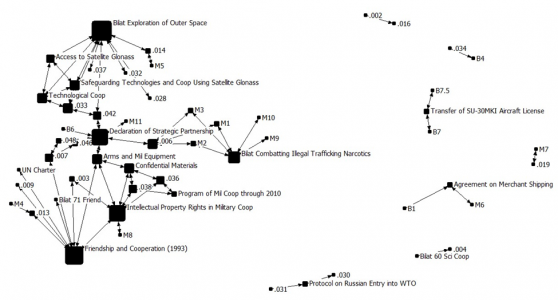
Figure 1: Network Map of Bilateral Treaties Between India and Russia from 1947-2017
In addition to this, even though the Indo-American bilateral ties have made dramatic progress in the last two decades, they remains weakly institutionalized. Most treaties in the Indo-American relationship (and there are fewer compared to the other bilateral relationships) are standalone treaties leading to what we term “ad hoc cooperation”. This suggests that while India and the United States are engaging in cooperation on certain issues, this has not led to an effort to create a strong foundation for cooperation. There are no lodestone treaties in the Indo-American relationship which can serve as the basis for an overall cooperative relationship. Cooperation in the Indo-American dyad is limited to certain issue areas, unlike the cooperation in the Indo-Russian dyad which spans multiple issue areas that are all interconnected.
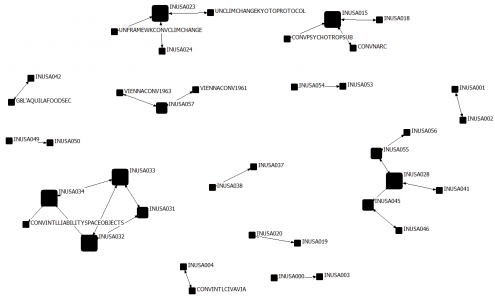
Figure 2: Network Map of All Bilateral Treaties Between India and the USA from 1947– 2017
This systematic analysis of India’s bilateral treaties with major power states suggests that the Indo-Russian relationship is the strongest amongst all the bilateral ties examined in the book. Indo-Russian cooperation spans several issue areas; it has been nurtured by different leaders and governments in their respective countries during the past century. As a result, India is unlikely to take an overtly critical approach against Russian aggression in Ukraine. However, given India’s commitment to the international principles of multilateralism, non-interference and respect for territorial integrity and sovereignty, it may continue to pay lip service to the idea of peaceful resolution of the dispute.
Diplomats and scholars alike are urging India to take a firm stand, to rise to the occasion and to condemn the atrocities being committed by Russia against Ukrainians. The United States has made it clear that any country that continues to maintain economic ties and trade relations with Russia will be tainted by association. In the past the Trump administration granted India a waiver to continue to trade with Iran (which has also been placed under heavy sanctions due to its violation of the US – Iran nuclear treaty). It remains to be seen if the United States will be able to pressurize India to take a stand against Russia by publicly condemning their actions in Ukraine as well as sever close economic ties. Our research suggests that both scenarios are unlikely to happen.
If the United States wants to ensure India’s support and cooperation against revisionist states such as Russia, they will have to work to build an institutionalized cooperative relationship with India.
This will require cultivating close ties in various areas and not treating India as a junior partner in Asia, that is only useful to balance the rise of China.
This article was also published on the London School of Economic's South Asia Blog which can be accessed here.
About the author
Aakriti Tandon
Aakriti Tandon is an Associate Professor of Political Science at Daemen College, Amherst NY. She is an expert on international institutions, international security as well as Indian foreign security policy. She has published several articles on India's bilateral relations with major power states such as the United States as well as Russia, and India's bilateral ties with neighboring states such as Pakistan. She (along with co-author Michael O. Slobodchikoff) edited a special volume of The Roundtable: The Commonwealth Journal of International Affairs on the topic of Security in South Asia. Their upcoming book is titled India as Kingmaker: Status Quo or Revisionist Power (University of Michigan Press).

Michael O. Slobodchikoff
Michael O. Slobodchikoff is an expert on Russian relations with post-Soviet states. He has published many books on this topic. His most recent book is titled The Challenge to NATO: Global Security and the Atlantic Alliance, published in 2021, and co-authored with G. Doug Davis and Brandon Stewart. He is also the editor of the Russian, Eurasian, and Eastern European Book Series through Lexington Books. Dr Slobodchikoff specializes in relations between Russia and the former Soviet states, international conflict and peace, security, and comparative politics. He has often served as an analyst on Russian relations with Ukraine for BBC World News.


.jpg)